How Do You Know If Your Workplace Climate Is Healthy?
Most people have an instinctive sense of whether their workplace feels energising or draining.
You might describe it as the atmosphere, the environment, or simply the way things feel around here. But instinct alone can be difficult to explain, and even harder to improve.
So how can you actually measure whether a working environment is healthy, productive, and supportive of best performance, problem solving, innovation, and change?
One tool designed to answer that question is the Situational Outlook Questionnaire® (SOQ).
The SOQ is an assessment instrument that examines the psychological climate of a workplace. In simple terms, it helps organisations make something that is normally invisible – the everyday environment people experience – measurable and visible.
Understanding this climate allows leaders and teams to move beyond assumptions and begin working with real evidence about how their workplace actually feels and functions.
Culture Vs Climate
The terms culture and climate are often used interchangeably, but they refer to different aspects of organisational life. Understanding the distinction is important for anyone interested in improving aspects such performance, innovation, resilience, or engagement.
Culture refers to the deeper values, beliefs, and assumptions that underpin how an organisation operates. It evolves over long periods and can be difficult to change quickly. Climate, by contrast, reflects the day-to-day patterns of behaviour and interaction experienced by people working in a particular environment or team.
At Perspectiv, we often describe it as a tree. Culture is the roots, deep and difficult to change. Climate is everything above the ground, visible in daily behaviours and far easier to shape. This means climate is also far more measurable and changeable. Because it reflects current behaviours and interactions, leaders and teams can actively influence and improve it.
Three distinctions are particularly useful:
Climate is local
Culture usually requires looking at the organisation as a whole. Climate can be examined at a team, department, or project level, allowing for much more focused insights.
Climate is measurable
While culture tends to describe how an organisation operates, climate can be measured against dimensions known to support creativity, collaboration, and productivity.
Climate is changeable
Because climate reflects everyday behaviours, it is more responsive to leadership actions and team practices.
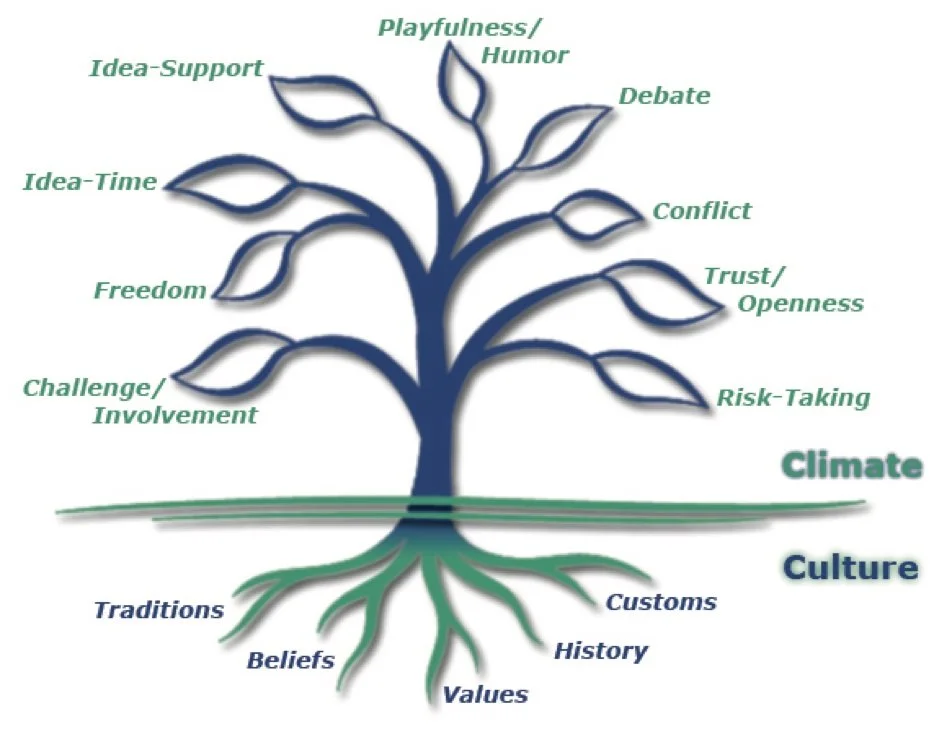
The nine dimensions of workplace climate
40 years of research behind the SOQ identifies nine dimensions that describe the health of a working environment. Together, they paint a picture of how people experience their workplace.
Challenge and Involvement: The degree to which people are involved in daily operations, long-term goals and visions
Freedom: The independence in behaviour exerted by the people in the organisation
Trust and Openness: The emotional safety in relationships
Idea-Time: The amount of time people can (and do) use for elaborating new ideas
Playfulness and Humour: The spontaneity and ease displayed in the workplace
Conflict: The presence of personal tensions in the organisation
Idea-Support: The ways new ideas are treated
Debate: The occurrence of encounters and disagreements between viewpoints, ideas, experiences and knowledge
Risk-Taking: The tolerance of uncertainty and ambiguity in the workplace.
Together, these dimensions create a practical framework for understanding the real experience of working within a team or organisation.
How organisations use the SOQ
The SOQ is commonly used in three ways.
1. Leadership development
The SOQ can be used as a 360-degree leadership development tool.
Leaders assess the climate they believe exists around them, while colleagues and team members provide their own perspectives. Comparing these views often highlights perception gaps and provides clear direction for leadership development.
2. Team development
Climate can vary dramatically between teams within the same organisation.
Research shows that the difference between the best and worst teams can be striking. For example, Trust and Openness can be three times higher in the best performing teams than in struggling ones.
By identifying where climate strengths and weaknesses exist, teams can focus on the specific behaviours that improve collaboration and performance.
3. Organisational development
At an organisational level, climate has been shown to influence a range of outcomes including:
creativity
innovation
quality
employee engagement
return on capital employed
Understanding climate helps organisations target improvement efforts where they will have the greatest impact.
Is the SOQ reliable?
For any assessment tool to be useful, it must demonstrate reliability and validity.
The SOQ has been studied extensively over more than forty years. The Buros Center for Testing, widely regarded as the gold standard for evaluating assessments, summarises the research as follows:
“They make a strong argument for the effect of organisational climate on change, creativity and innovation… Fifty years of documented research and development provide a level of confidence for both qualified practitioners and their clients. The SOQ is recommended for its intended purposes.”
This long research history provides strong confidence that the SOQ measures what it is intended to measure and produces meaningful insights for organisations.
What does an SOQ assessment produce?
The SOQ assessment contains two parts.
Part A – Climate measurement contains 53 questions that generate scores across the nine climate dimensions.
Results typically include:
average scores across each dimension
variations within teams or groups
comparisons against normative data
comparisons with previous assessments
This allows organisations to see whether their climate resembles those found in innovative, average, or stagnating organisations.
Part B – Open insight
An optional second section invites participants to describe:
factors that help the climate
factors that hinder it
suggestions for improvement
These responses often provide valuable qualitative insights that bring the data to life while maintaining participant confidentiality.
Additional analysis can also explore links between climate and other factors such as:
creative problem-solving orientation
perceptions of creative outputs
observed leadership practices
A practical way to understand your environment
Workplace climate influences far more than mood or morale. It shapes how people think, collaborate, experiment, and perform.
The challenge is that climate is often discussed informally but rarely measured.
Tools such as the SOQ provide organisations with a way to understand the environment they are actually creating and to take deliberate steps to improve it. Because when organisations can see their climate clearly, they can begin to shape it intentionally.
If you’re curious about what the climate in your organisation looks like, Perspectiv can help facilitate an SOQ assessment and guide the conversations that follow.
References:
For more on Climate vs Culture, check out our article on Ferrari a look into climate from the top down.