#ElkannOut a story about climate
The What
In November 2025, Ferrari found itself in the headlines for all the wrong reasons as chairman John Elkann went unusually public with a critique of his own Formula 1 drivers after a miserable São Paulo Grand Prix weekend, a race that saw both Charles Leclerc and Lewis Hamilton fail to finish (DNF). Rather than just lamenting the team’s performance, Elkann told the pair via the press that they needed to…
.jpg)
“Focus on driving and talk less,”
- John Elkann Nov 2025
Implying the team lacked unity and suggesting some elements (yes, drivers included) were “not up to par” this season.
His comments padded praise for the mechanics and engineers but drew a mixed reaction from fans and pundits with some labelling the remarks demoralising and counter-productive given Ferrari’s struggles. Hamilton and Leclerc, for their part, responded with determination rather than drama, issuing rallying calls for unity and performance as the season headed towards its finale, while insisting there’s no blame culture despite the fireworks from the top.
Love him or hate him, Elkann’s blunt message has certainly stirred the Tifosi*, and maybe raised more questions about leadership off the track than performance on it.
So What?

Lewis Hamilton - Imola 2025 by Jen_ross83
First, let’s talk about Lewis Hamilton. A seven-time world champion doesn’t accidentally forget how to race a car. Hamilton has worn pressure like a second skin at McLaren and Mercedes, delivering championships under relentless scrutiny. As for Ferrari (a team that hasn’t won a drivers’ title in a very long time) to publicly question his focus feels less like accountability and more like projection.
Then there’s Charles Leclerc.
Calling into question Leclerc’s effort borders on unfair. He’s widely regarded as one of the fastest drivers on the grid and, race after race, appears to be extracting everything the car has to give. More than that, Leclerc is Ferrari. To imply a lack of commitment from someone so deeply embedded in the team’s identity feels not only inaccurate, but just unnecessarily harsh. For those who are unaware of Leclerc’ story to F1, I recommend you familiarise yourself with his fascinating story.
Which brings us to the bigger question: what does this say about the team?
Publicly criticising your drivers, especially when they are two of the most proven and loyal talents in Formula 1, sends a message far beyond the paddock. It signals a culture where pressure flows downward, blame is externalised, and leadership commentary happens through the press rather than behind closed doors.
And if that’s what’s said publicly, one has to wonder what the internal climate feels like.
At Perspectiv, we distinguish clearly between climate and culture. Climate is situational, measurable, and changeable. It reflects how it feels to work somewhere, the lived experience of leadership behaviours, decision-making, pressure, and trust. Culture runs deeper. It is the accumulated history, values, and identity of a system.
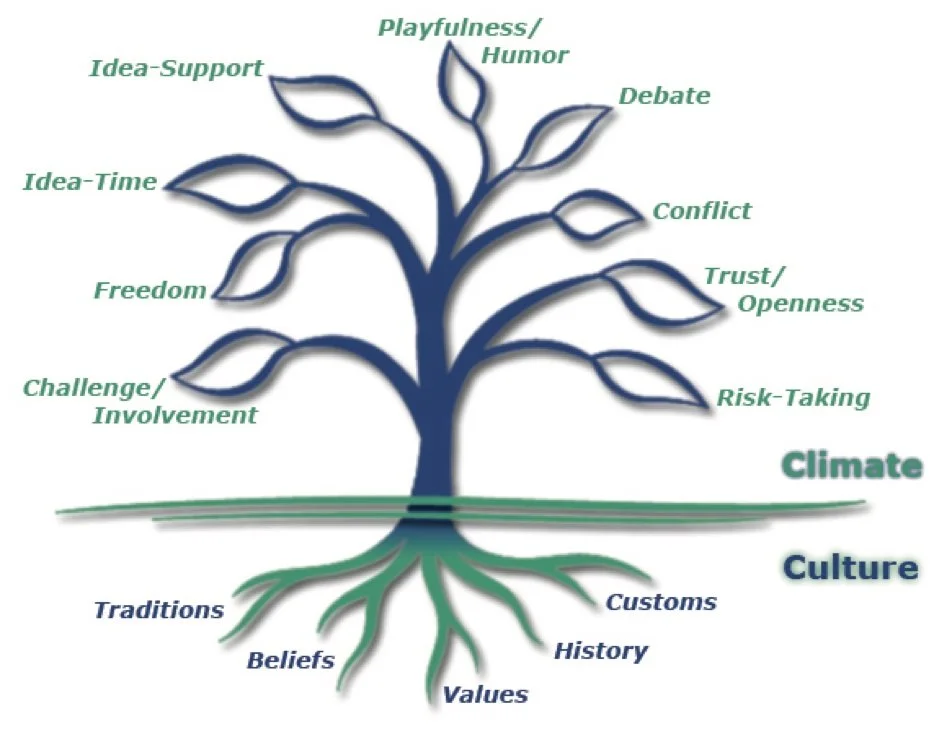
If you imagine a tree, climate is the visible growth above the ground. Culture is the root system beneath it.
You describe culture.
You measure climate.
Great teams don’t win by questioning commitment, they win by creating environments where trust, challenge, and support that allows exceptional people to perform at their best. When leaders reach for criticism instead of curiosity, the problem usually isn’t the drivers… it’s the system they’re driving within.
And that means it is a leadership problem.
Now What?
Why do stories like this matter and why should it matter to you and I?
Formula1 is an elite club that most of us will never enter, but the world of sport offers some of the clearest illustrations of the principles we teach at Perspectiv.
At its core, this story is about a team falling short of its goal under the weight of a demanding leader who chooses to criticise publicly rather than support privately. A situation many of us have experienced first-hand or can easily imagine. We work with senior leaders like the Elkanns of this world, to help them examine the climate they are creating. Not the one they intend to create. The one people actually experience. The first step is awareness. We often say:
The fish are the last to discover the water. *
Leaders are immersed in their own habits, language, and pressure responses. Without data, they cannot see the environment they shape. If Elkann were motivated to change course, Perspectiv would begin by diagnosing the psychological climate around him. We would use an instrument such as the Situational Outlook Questionnaire (SOQ) to gather 360-degree data across 9 dimensions of climate. Because here’s the truth we share with every senior stakeholder:

Everything you say is said through a megaphone.
The data from SOQ provides a clear picture of the impact a leader is having on the climate. Not their intentions, but their effect. From that SOQ data, coaching would focus first on interrupting behaviours that negatively affect climate and then move on to establishing leadership behaviours that foster the 9 dimensions of psychological climate such as trust, challenge, and support. But the work does not stop at the individual. Climate is also shaped through everyday interactions: how meetings are run, how mistakes are handled, how dissent is treated, how difference is received.
In environments with strong identity, difference can sometimes feel like disruption, but High Performance does not come from sameness. It comes from diverse perspectives held together by a healthy climate. At Perspectiv, we often say:
“I don’t care about your culture — we celebrate it. You describe culture, not measure it.”
Which brings us to something deeper.
Ferrari is not just a team. It is an institution woven into Italian sporting and cultural identity. The Tifosi* do not simply support Ferrari, they embody it. This could be one of the limiting factors in their failure to succeed. Just because they have been the most successful formula one team in the past, does not guarantee you success in the future. This is perhaps one of the fundamental reasons there is a clash in their organisation. They have some of the best drivers in the world saying we need to do things differently, whilst their leaders are saying we know how to run things.
What we measure and what we help leaders improve, is the climate that allows that culture to thrive. Because people being different is not a weakness. It is an advantage.
The question is whether the climate allows that advantage to surface.
References
* The Tifosi, as they are known, are the intensely passionate, loyal supporters of the Scuderia Ferrari Formula 1 team
** “The fish will be the last to discover the water” is a proverb we use to help people to see and then understand the environment they are in and which they influence – either positively or negatively. People are so immersed in their own environment; they often take it for granted and may not recognise its significance until they are removed from it. This proverb highlights the idea of familiarity leading to a lack of awareness about one's surroundings. It suggests that people who only know their own patterns may regard them as inherently right, failing to see other perspectives. Additionally, it reflects a philosophical view that one is enveloped by their environment, much like a fish in water.