Building the 'Climate' for Innovation
High performing people, teams, and organisations don’t accept the status quo. They actively shape the conditions that allow innovation to happen. That starts with climate.
In this piece, we’ll explore what we mean by climate, why it matters for innovation and performance, and how you can begin to improve it.
The physical and psychological environment
When people describe their workplace, they often use words like culture, atmosphere, or environment interchangeably. But these concepts are not the same, and the differences matter.
The physical environment is the most visible. Offices, layout, tools, and surroundings all play a role. At a minimum, they need to function well. If they don’t, people quickly become distracted, disengaged, and demotivated.
But improving the physical environment alone rarely drives meaningful change. It is the psychological environment that has the greatest impact.
This is what shapes people’s:
energy
engagement
productivity
openness to learning
creativity and innovation
Research suggests that when the psychological environment is right, performance can improve by 20 to 60 percent.
As Göran Ekvall, Scott Isaksen, and others observed:
“No single separate influence produces a more lasting effect on behaviour and feelings than the daily exposure to a particular psychological atmosphere.”
Culture and climate
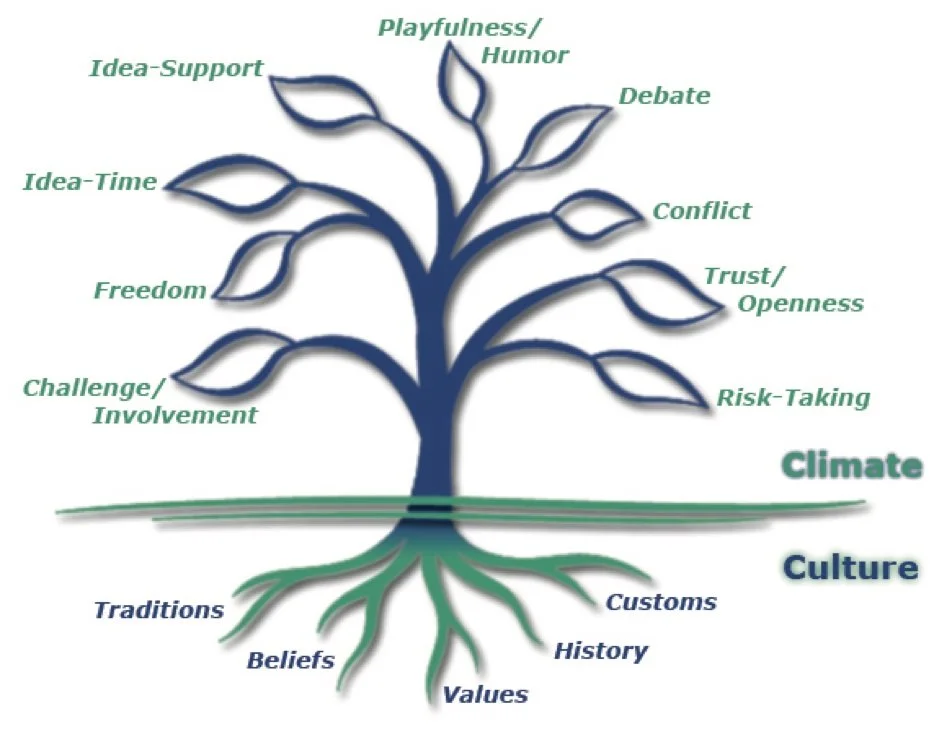
Culture and climate are both part of this psychological environment, but they operate in different ways. Culture is deep-rooted. It reflects shared values, beliefs, and assumptions across an organisation. It takes time to form and is difficult to shift.
Climate is more immediate.
A useful way to think about it is this:
Culture is the roots of a tree. Climate is what’s happening above ground.
Climate is local, visible, and experienced day to day. It shapes how people behave, how they interact, and how they approach their work.
Unlike culture, climate is measurable and changeable, and importantly, it has a direct impact on performance.
How do you build climate?
Climate is not accidental. It is created through consistent behaviours, expectations, and ways of working. Over decades of research, nine dimensions have been identified as the key building blocks of a productive, innovative climate. These sit at the heart of the Situational Outlook Questionnaire® (SOQ), and provide a practical way to assess your environment.
As you read through them, consider your own team or organisation. Where would you score each one on a scale of 1 to 10?
Challenge and Involvement: How engaged and committed are people to the work?
Freedom: How much autonomy do people have within clear boundaries?
Idea Time: Do people have space to think before acting?
Idea Support: Are new ideas encouraged and developed?
Trust and Openness: Do people feel safe to speak honestly?
Playfulness and Humour: Is there room for energy, informality, and fun?
Conflict: Is tension productive or personal? (Lower scores are better here.)
Debate: Are different perspectives actively explored?
Risk Taking: Is it safe to try, fail, and learn?
Where to start
If innovation feels slow, forced, or inconsistent, the answer is rarely just better ideas. It is usually the environment those ideas are trying to survive in.
The nine dimensions above offer a simple but powerful diagnostic. Used honestly, they highlight where your climate is enabling performance, and where it is quietly holding it back.
Because innovation is not just about capability, it is about the conditions you create every day.
If you have questions about the SOQ or about improving your organisational climate, please contact us.