
Beyond Marginal Gains: How Perspectiv Helped the English Institute of Sport Rethink High Performance
In elite sport, the difference between winning and losing can come down to the smallest details. When the English Institute of Sport (EIS) wanted to explore new ways to improve performance, Perspectiv helped its people look beyond the physical and technical to challenge existing thinking and discover how even the best can become better, uncovering new possibilities in the pursuit of peak performance.
[EDITORIAL NOTE — ADD PHOTO HERE]
Suggested image: Team GB celebrating at the Rio 2016 Olympics, ideally with athletes holding medals or standing on the podium. Alternatively, use a relevant EIS training or coaching photograph.
Ensure image licensing and permissions are secured.
The challenge: How do you improve when you're already among the best?
In 2012, Great Britain delivered an extraordinary performance at the London Olympic Games, winning 65 medals in front of a home crowd. A truly historic moment in time. The challenge now was finding a way to build on that success, because there is an interesting trend that happens after hosting an Olympic Game for a country.
History suggested that the next Olympic Games would be considerably harder. Host nations traditionally benefit from competing at home, and no country in modern Olympic history had managed to improve its medal tally at the Summer Games immediately after hosting.
For Great Britain, this was different.
After we hosted the 2012 games, we managed to win not 1, but 2 more medals than when we previously hosted it. This had not been done in modern Olympic history . What makes this even more astonishing is that even PWC predicted we would win less. An economic analysis by PwC predicted that Great Britain would win just 52 medals at Rio 2016, a substantial decline from London 2012. https://www.pwc.co.uk/economic-services/assets/olympic-medals-paper-2016.pdf
We used data from https://www.olympedia.org/ to compile a spreadsheet outlining this phenomenon.
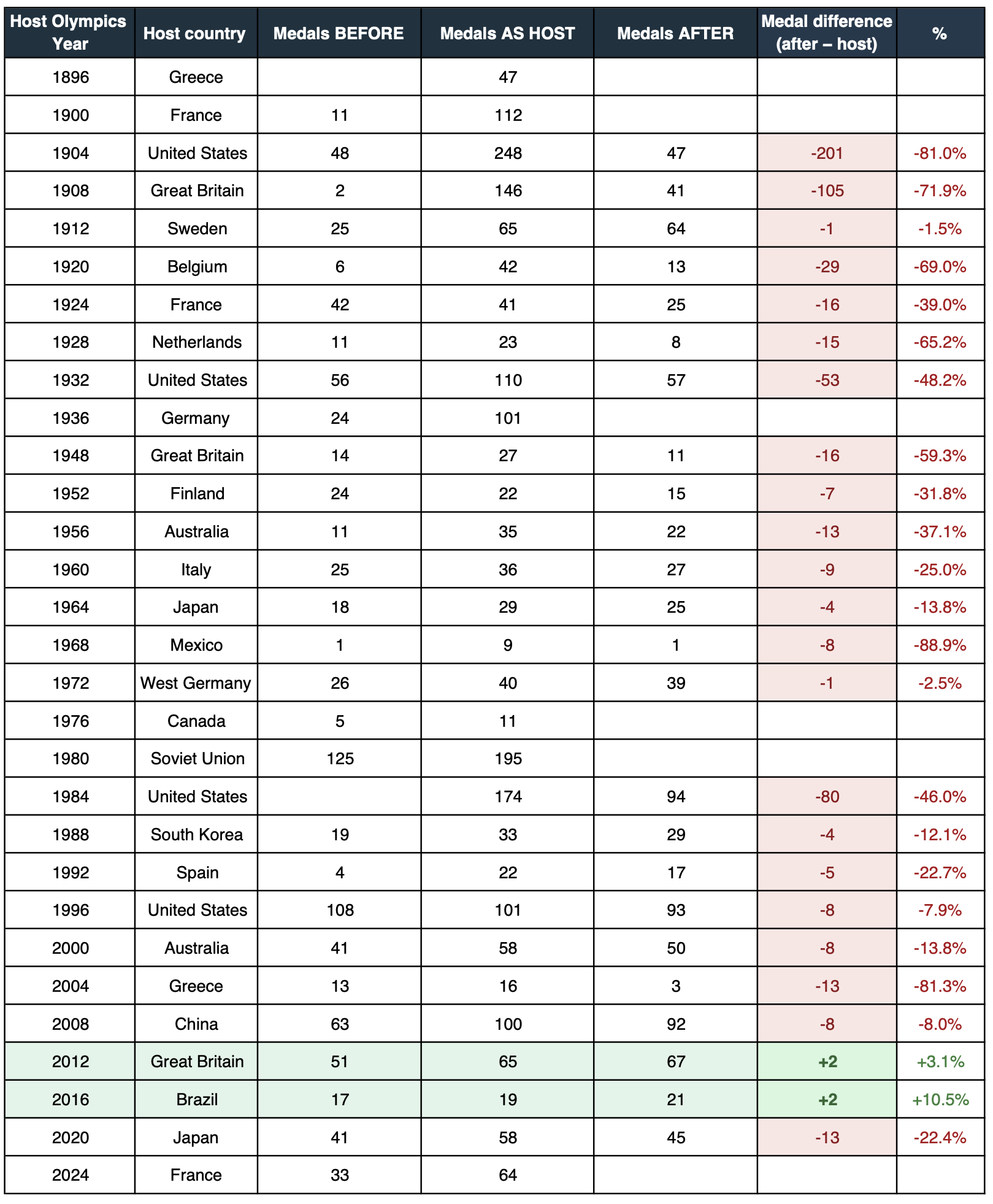
Potential headline: Predicted to fall. Instead, Britain made history.
UK Sport's announcement confirming Britain's historic achievement:
PwC's pre-Games Olympic medal prediction:
https://www.pwc.co.uk/economic-services/assets/olympic-medals-paper-2016.pdf
Now you know the story, I want to take you back in time to how Perspectiv got involved, and explain the story of what we did to contribute.
The challenge was clear: how could it build on the success of London 2012 and achieve something that had never been done before? - need a better link
By this point, the British high-performance sporting system was already operating at an exceptional level. Sports scientists, coaches, performance specialists and medical professionals were continually searching for marginal gains: the small improvements that, when combined, can make the difference between standing on the podium and missing out.
But what if some of the greatest opportunities for improvement weren't physical or technical at all?
What if they were about people?
Finding the next 1%
In 2015, Chris McLeod, working within the English Institute of Sport (EIS), encountered Perspectiv's approach to Facilitative Leadership and Creative Problem Solving through the Master's in Innovation, Creativity and Leadership programme at the Bayes Business School in London that was taught by Andy. After witnessing the content on the course was built upon scientific backing, he recognised an opportunity.
EIS was accustomed to rigorous scientific thinking. Its performance specialists understood how to analyse data, develop athletes and refine established methods. Perspectiv offered a complementary perspective: a research-based approach to understanding the complex human factors that influence performance. This meant looking at challenges that don't always have straightforward answers: communication, relationships, leadership, collaboration and the psychological environment in which people work. Working with Alex Wolf, then a learning and development leader at EIS, Chris helped bring Perspectiv into the organisation.
The ambition was not to replace the technical expertise already delivering results. It was to unlock additional possibilities for improvement by helping people think, work and lead differently.
[EDITORIAL NOTE — ADD TESTIMONIAL HERE]
Potentially use Alex Wolf's existing Perspectiv testimonial:
"Like a Trojan horse, Perspectiv's unassuming idea of Facilitative Leadership spread quickly, to a point where it is now part of the organisation's fabric."
The approach: Creating the conditions for people to perform at their best
Perspectiv delivered its Facilitative Leadership and Creative Problem Solving (FL-CPS) programme to approximately 40 EIS professionals. This included coaches, performance specialists, and those responsible for supporting the Olympic athletes directly. Through face-to-face workshops, participants explored practical, evidence-informed approaches to leadership, creative problem solving and team dynamics.
[EDITORIAL NOTE — ADD PHOTO HERE]
Use one showing Perspectiv delivering the workshops or EIS participants engaging in learning activities.
Central to the programme was an important shift in perspective. Rather than seeing leadership as having all the answers, participants were encouraged to understand how leaders can create the conditions in which others contribute their best thinking. Perspectiv introduced tools and frameworks that gave people a shared language for recognising challenges, asking better questions, working through uncertainty and identifying opportunities for improvement. One particularly important area was psychological safety in climate: the conditions that influence how comfortable, motivated and able people feel to contribute and perform.
In elite sport, even seemingly minor interpersonal decisions can have consequences.
Consider athletes travelling to a major international competition. Decisions about accommodation and who shares a room may appear insignificant compared with training schedules or physical conditioning. Yet these details can affect rest, confidence, relationships and ultimately an athlete's ability to perform. This is just one of the many factors that can be considered when in the pursuit of gaining a performance advantage.
By examining these less obvious factors, EIS could approach performance from a broader perspective.
The aim was to make previously overlooked opportunities visible, and give people practical ways to act on them.
[EDITORIAL NOTE — ADD COMMENT OR QUOTE FROM POWERPOINT HERE]
Review Andy's EIS PowerPoint, particularly slide 4, for the comment about organisations looking for a "silver bullet" instead of having honest conversations about what they don't know.
This could be an effective pull quote illustrating the shift from seeking quick answers towards exploring complex problems. Check exact wording, speaker and publication permission.
[EDITORIAL NOTE — ADD LINK TO BRIAN DORVAL MASTERCLASS HERE]
Brian Dorval delivering a masterclass involving EIS and Perspectiv's problem-solving approaches.
Title:Watch: Creative Problem Solving in Practice — Brian Dorval Masterclass
From learning to action: What It Takes to Win
The work went beyond participation in a training programme, EIS drew on the approaches explored through Perspectiv's FL-CPS programme to develop its own strategic review process, documented in a framework called What It Takes to Win. This helped professionals consider what individual sports needed to improve, explore their challenges and identify opportunities for progress. - Check this
Rather than treating performance as a purely technical problem, the approach encouraged a more complete understanding of the factors that contribute to success. It also supported a different kind of conversatio, one in which people could challenge assumptions, share knowledge and examine difficult questions without needing to pretend they already knew every answer.
Perspectiv's contribution was to help EIS build these capabilities within its own organisation. That distinction matters. The objective was never for EIS to depend on an outside consultancy to solve every problem. It was to equip its people with approaches they could continue applying themselves.
[EDITORIAL NOTE — ADD LEAD MAGNET HERE: "WHAT IT TAKES TO WIN"]
This is an opportunity to turn the case study into a lead-generation tool. Rather than giving visitors an immediate PDF link, offer access in exchange for their email address.
Suggested website content:
Discover What It Takes to Win
What does it take to achieve high performance when you're already operating among the best?
Explore the English Institute of Sport's What It Takes to Win document, developed to support its approach to reviewing performance and identifying opportunities for improvement.
Discover how structured problem solving, better questions and a deeper understanding of people can help organisations find new ways forward.
Enter your email address below and we'll send you a copy.
[Email address: __________________]
[Send me the document]
We'll use your email to send the requested document. You can separately opt in to receive further insights from Perspectiv.
Implementation notes:
Connect the form to Perspectiv's CRM or mailing system
Send the document automatically after form submission
Include a separate, optional marketing-consent checkbox
Add a privacy-policy link and track submissions as website conversions
The result: Making Olympic history
When the Rio Olympic Games concluded in 2016, Great Britain had achieved something unprecedented:
London 2012: 65 medals. Rio 2016: 67 medals.
For the first time in modern Olympic history, a host nation had increased its total medal count at the following Summer Games. Great Britain finished second in the official medal table, ahead of China by gold medals won, demonstrating the remarkable strength of its elite sporting system.
The achievement was the result of years of work by athletes, coaches, sports scientists, governing bodies and the wider network supporting British Olympic sport. It would be wrong to attribute that success to any single programme or consultancy. What Perspectiv contributed was one part of that wider pursuit of excellence: helping EIS professionals develop new ways of thinking about performance, working with others and finding opportunities for improvement.
The significance of the engagement was not simply what people learned in the workshops. It was how those approaches could be taken back into the organisation and used to support ongoing improvement.
The investment behind Olympic success
Success at the highest level also requires significant investment. According to BBC Sport's analysis following Rio 2016, approximately £274.5 million was allocated to Olympic sports through UK Sport for the Rio cycle. Against Britain's 67 medals, this represented approximately £4.1 million per medal. This figure provides useful context for the investment required to sustain an elite sporting system. It does not represent the complete cost of Olympic preparation, nor does it establish how efficiently Britain performed compared with other countries.
[EDITORIAL NOTE — ADD SOURCE LINK HERE]
BBC Sport's Rio 2016 funding analysis:
https://www.bbc.co.uk/sport/olympics/37150155
[EDITORIAL NOTE — MORE INFO IN POWERPOINT]
Check whether the EIS presentation includes its own performance-efficiency calculations, investment targets or comparative data.
Avoid claiming that Britain was the world's most cost-efficient Olympic nation without comparable evidence.
May remove this section and reframe it to being about since 2016, consistently being in the top 5 because of the processes implemented.
The lasting lesson: High performance is about more than expertise
When an organisation is already performing at an exceptional level, further improvement can be difficult to find. The natural response is often to invest in more technical expertise, better processes or increasingly sophisticated tools. These things do matter of course, but they are only part of the picture. The experience with EIS highlights a lesson relevant to organisations far beyond elite sport: performance is shaped not only by what people know, but by how effectively they think, interact and work together. A leader's role is not simply to direct performance. It is to create an environment in which people are better able to achieve it.
[EDITORIAL NOTE — ADD FINAL TESTIMONIAL OR POWERPOINT QUOTE HERE]
Look for a testimonial from Chris McLeod or Alex Wolf that explains what changed in the way EIS professionals approached their work.
A quote demonstrating lasting changes in behaviour or leadership would be particularly effective here.
For Perspectiv, this is the foundation of sustainable high performance. By combining deliberate problem-solving processes, inclusive leadership and an understanding of psychological climate, organisations can uncover opportunities that conventional approaches may overlook. Whether the ambition is to win Olympic medals, deliver innovation, navigate complex change or improve everyday business performance, the underlying principle remains the same.
Better results begin by enabling people to be at their best.
May change this past part to be about problem A and B instead.
Could your organisation be overlooking its next opportunity for improvement?
At Perspectiv, we help leaders, teams and organisations develop the skills, processes and working environments that make high performance possible.
Explore our services or get in touch to discuss what better performance could look like for your organisation.
Internal publication checklist
Before publishing:
Source and obtain permission for the Olympic and workshop photographs.
Obtain and review Andy's EIS PowerPoint presentation.
Verify exact client testimonial wording and attribution.
Locate and verify the Brian Dorval masterclass video.
Obtain permission to distribute the What It Takes to Win document.
Build and test the lead-magnet email form and delivery process.
Verify medal figures and financial comparisons against the linked sources.
Confirm permission to publish the EIS engagement and client details.
Add links to relevant Perspectiv service pages and Insights articles.
Check final SEO title, meta description and image alt text.